Circular Ceremony
Published on:
Genesis
To grasp the concept of Dreamtime, one must think of it as the Aboriginal equivalent of the first two chapters of the Hebrew Book of Genesis, but with a significant difference. In Genesis, God first created “living beings” and then shaped Father Adam from clay. In Aboriginal cosmology, however, the Ancestors created themselves from the clay.
In a similar vein, Steve Roach becomes the demiurge of his own being: freeing himself from the cosmic aesthetic of his early works, moving through Structures from Silence and the Quiet Music series (where pointillist minimalism merges with Brian Eno’s ambient music), and ultimately revealing his most introspective side through a ritual electronic concept album.
Ritual of Sound and Memory
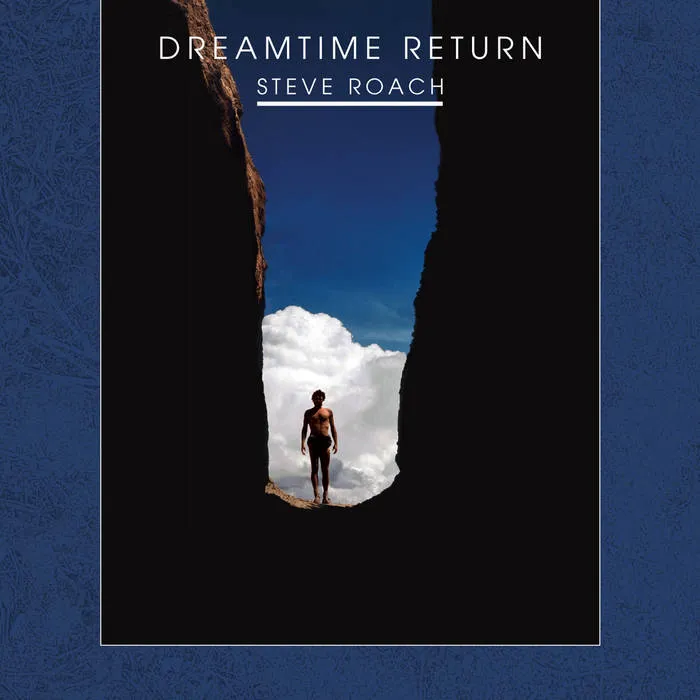
With Dreamtime Return, Steve Roach doesn’t just borrow a mythology, he orchestrates a passage. Inspired by his travels to Northern Australia and his immersion in Aboriginal sacred landscapes and ancient traditions, he frames the album as a sonic pilgrimage.
On the first disc, rhythms and percussive pulses emerge like the heartbeat of the Earth. The opening tracks, “Towards the Dream” and “The Continent”, drive the listener into a raw, elemental terrain, a place where primitive drum patterns and electronic sequences fuse, evoking a desert walk at dusk. Shadows lengthen, and something ancient stirs beneath the ground.
Then, in “Songline”, we enter ritualistic territory. Digeridoos and dense percussion patterns announce the beginning of the ceremony, evoking hypnotic campfire dances. With “Airtribe Meets the Dream Ghost”, everything darkens, leaving us on the verge of consciousness, suspended in oneiric tension, punctuated by primitive rhythms and electronic effects.
Suddenly, with the subliminal sounds and intermittent choirs of “A Circular Ceremony”, the album transforms: what began as a journey through external landscapes becomes a voyage inward, into psyche, memory, and dream. Here, Dreamtime, in its Aboriginal sense, merges with the dreamtime of the mind: ancestral memories, the collective subconscious, and primordial spirits.
Universal Subconscious
We reach “The Other Side” of this world (the inner world) where the landscape of the mind becomes as tangible as the desert plains outside. Here, Steve Roach’s electronics unfold with deeply emotional melodies, rising and falling over shimmering, drifting textures.
The journey deepens in “Magnificent Gallery”, where cosmic washes and subtle tonal shifts create a liminal field. Rhythms are sparse, almost absent, allowing the listener to navigate a dreamscape unbound by ordinary time. The music seems to float, suspending causality in favor of experiential resonance, forming an introspective cosmic sea.
The melancholic aural sonata “Truth in Passing” and the precarious “Australian Dawn” introduce the album’s most intense passage: “Looking for Safety”.
For more than half an hour, the music becomes a slow-moving current: minimal melodic fragments drift and reemerge, morphing across time, suspended in a vast cosmic sea. In this extended span, the album abandons prior rhythm or ceremony, leaving only the vast inner space, the echoing void, and the primal pulse of being. It feels like a slow descent into the underworld of memory, a contemporary liturgy for the human soul.
With “Through a Strong Eye”, we reach the darker frontier of the journey. Acting as a coda to “Looking for Safety”, the growling rumble that had lingered in the background of the previous track now emerges, followed by electronic dissonances. This shift in sonic tension mirrors a transition into the unknown, a deeper communion with the spirit world. Here, the shaman, through their “strong eye”, the eye through which they read the future, enters a trance, allowing the darkness to reveal hidden truths. Destabilizing, almost unsettling energies are released as we cross the threshold between worlds, blurring the line between the living and the ancestral.
Rebirth of Consciousness
As the “strong eye” vision slowly fades, we seem to re-emerge into the material world. Organic drums return in “The Ancient Day”, building a hypnotic and uplifting rhythmic crescendo. In “Red Twilight With the Old Ones”, we are back to the initial ritual, where the old ones sing ritualistic chants, accompanying the end of our journey, and our return.
The final track, “The Return”, emerges as waves of synths crashing into our consciousness, signaling a calm awareness of rebirth. The cyclical journey of myth and psyche completes its arc: from Earth to inner space, to catharsis, to renewal.
In this sense, Dreamtime Return is not a fixed narrative but a ritual loop, like the endless cycles encoded in Aboriginal cosmology, where creation and memory, time and eternity, collapse into one another.